
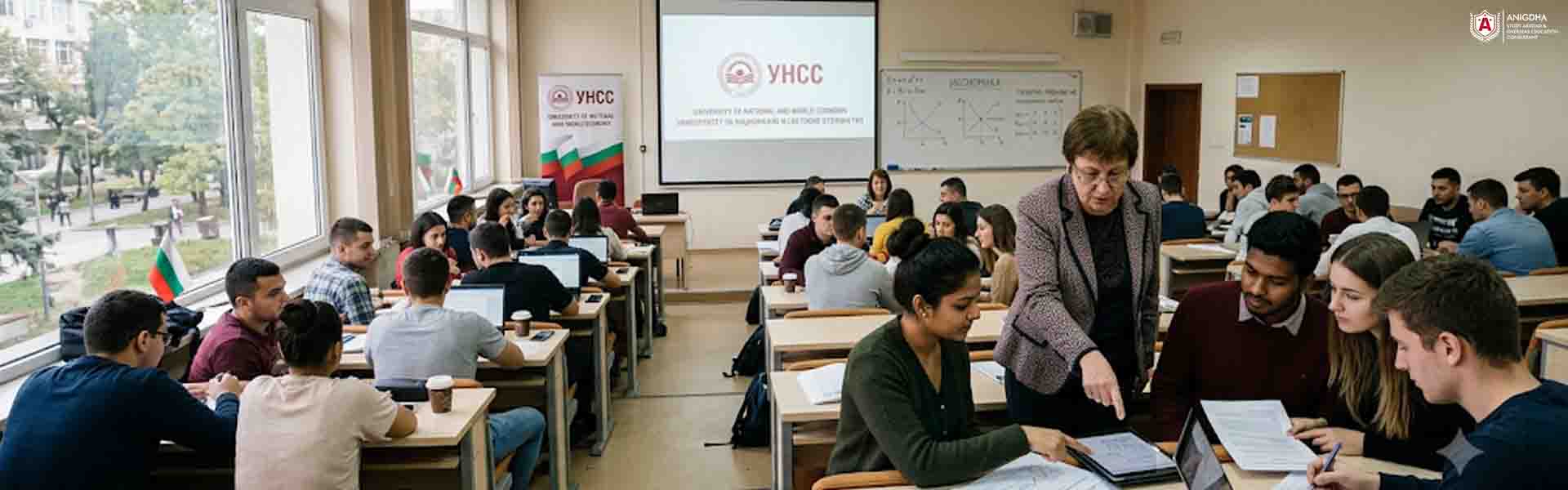
Study Economics in Bulgaria: Universities, Fees, Eligibility & Admission
A career in economics can take you into different fields and Bulgaria gives you an affordable path to build that foundation. Study economics in Bulgaria and build a rewarding career. There are many excellent universities in Bulgaria for those willing to pursue this degree. Here, you can expect top-notch education with the help of experts in the field. Added to this is the excellent infrastructure and the very affordable fee structure for higher studies in Bulgaria. When you choose to study economics in Bulgaria, you will be able to gain a better understanding of taxation, interest rates, international trade, inflation, monetary policies, etc. You will be able to get jobs across various sectors. Whether you wish to work in academia, business, government or any other sector, the learnings of this degree are very useful to you. In this guide, we are going to cover the eligibility criteria, top universities, fees, admission process, visa requirements and scholarships that can help you plan your economics degree in Bulgaria with confidence.
Are you interested in knowing more about the bachelor degree in Economics? Then read on!
Study Economics in Bulgaria: Quick Overview
| Particulars | Details |
| Popular Intakes | June (regular) and November (spring) |
| Top Universities | American University in Bulgaria, University of National and World Economy, Sofia University |
| Course Duration | Bachelor’s is 4 years, Master’s is 1 to 2 years |
| Medium of Instruction | Bulgarian and English |
| Tuition Fees | Around €1,900 to €4,200 per year at public universities |
| Cost of Living | Around €500 to €700 per month |
| Part Time Work Limit | Up to 20 hours per week during the semester |
| Visa Required | Bulgaria Type D student visa |
Why Choose Bulgaria for an Economics Degree?
If you have chosen Bulgaria as your next destination, then you must look at its benefits:
- Recognised degree: An economics degree in Bulgaria carries the same value as any other EU country while letting you build your career or continue your studies anywhere in Europe.
- Affordable tuition: Public universities charge a nominal fee of around €2,000 to €4,000 per year for economics fees in Bulgaria, which is much more reasonable compared to countries like Germany or the UK.
- English taught programs: If you are an Indian student, you can also explore English taught programs in Bulgaria, so you can start your study without worrying about a new language.
- Simple admission process: Getting into an economics university in Bulgaria is comparatively easier as most universities do not follow restricted seats or tough entrance exams.
- Low cost of living: A monthly budget of around €500 to €700 can cover your accommodation, food and daily expenses while keeping your overall cost of studying manageable.
- Growing career scope: Bulgaria’s banking, finance and consulting sectors can open doors for economics graduates, so you can explore wide career opportunities within Bulgaria and across Europe.
- Work and Recognition: Bulgaria gives you an option to work part-time up to 20 hours a week alongside your degree, so you can gain real experience while managing some of your own expenses.
Study Economics in Bulgaria: Eligibility Criteria
The eligibility criteria for studying bachelors in economics from Bulgaria are very simple. Let us have a look at these:
- You should have a minimum educational qualification of up to 10+2 level, with a minimum of 62% marks.
- Some economics universities in Bulgaria ask you to write an essay of around 650 words that describes why you want to learn your economics course in Bulgaria from that specific university.
- Some colleges in Bulgaria conduct interviews to understand your motivation levels and analyze your qualifications. The mode of interview may either be online or offline.
- SAT or ACT scores may be required, but this is optional and it applies to some universities only.
You should possess proficiency in the English language to study for a bachelor’s in Bulgaria. The tests whose scores are considered include
- TOEFL – 80
- IELTS – Band 6
- Cambridge First Certificate English (FCE) – Pass grade C
- Cambridge Advanced English Certificate (CAE) – Pass grade C
- Duolingo English Test – 110 score
English Requirements to Study Economics in Bulgaria
The language of instruction used for teaching bachelor courses in Bulgaria is English. You will have to prove your proficiency if you wish to get admission to your economics course in Bulgaria. You can do this by appearing for the English proficiency tests.
Economics Intakes and Deadlines in Bulgaria
Regular admissions in Bulgarian universities for bachelors in economics from Bulgaria are usually in June. On the contrary, the spring admissions deadline is around November. If you seek priority admission, which gives you the best chance of a scholarship, you need to submit your application by mid-January and if you want early admission, the application deadline is around March.
Documents Required for Economics in Bulgaria
Documents are a necessary part of your admission journey. Hence, you must be aware of all the documents required for economics in Bulgaria to get admission to your bachelor’s in economics in Bulgaria:
- Completely filled out an application form from the university.
- Essay of 650 words.
- Transcript of education up to the qualifying examinations.
- Mark sheets of 10+2 levels.
- English proficiency certificates.
- CV or portfolio.
- SAT or ACT results (optional)
- A copy of the application for financial aid (optional)
- Passport
- Visa
- Photographs (passport-sized)
How Long Is an Economics Degree in Bulgaria?
A regular bachelors in economics from Bulgaria will last for 4 years in Bulgaria. During this duration, you will get to learn about the principles of microeconomics, quantitative methods in economics, energy economics, money and banking, economic history, global political economy, intermediate macroeconomics, macroeconomics and crises, etc.
Economics Course Fees in Bulgaria
Here is the fee structure for studying your economics degree in Bulgaria:
| Name of the University | Fee structure per year |
| American University in Bulgaria | EUR 12,900 (EUR 6,450 per semester) |
| University of National and World Economy | EUR 3,800 |
| University of Economics Varna | EUR 2,700 |
| Sofia University St. Kliment Ohridski | EUR 1,900 to EUR 3,850 |
| New Bulgarian University | EUR 4,205 |
Additional Costs of Studying Economics in Bulgaria
Apart from your tuition fees in Bulgaria, you need to manage several other expenses separately. Here is a breakdown of these costs:
| Expenses | Approximate Cost |
| Type D student visa fee | €100 |
| Health insurance (minimum €30,000 coverage) | €50 to €100 per year |
| Document legalisation and translation | €50 to €100 in total |
| One-way flight from India to Bulgaria | €300 to €500 |
| Bank statement as a proof of funds | €5,000 to €6,000 |
| Study materials per semester | €50 to €100 |
All these expenses together sum up the overall cost of studying economics in Bulgaria.
Top Universities to Study in Economics
Are you looking for the best university from which you can pursue a bachelors in economics in Bulgaria? Here are the top 5 that offer this course:
| Name of the University | Category | Location |
| American University in Bulgaria | Private | Blagoevgrad |
| University of National and World Economy | Public | Sofia |
| University of Economics Varna | Public | Varna |
| Sofia University St. Kliment Ohridski | Public | Sofia |
| New Bulgarian University | Private | Varna |
How to Apply for Economics in Bulgaria?
Now that you have a clearer idea of the eligibility criteria, top universities for studying bachelors in economics in Bulgaria, and the documents required, you must be interested in knowing the process you need to follow for economics admission in Bulgaria. Let us walk you through these:
- Get in Touch for a Consultation: You can start by getting a one-on-one consultation from the experts. We will thoroughly discuss your goals and preferences. Then, we will help you understand which is the right study program for you.
- Choose a College: Next, we will help you choose the ideal college offering your economics course in Bulgaria.
- Documentation: Our counselors will also help you collect all the necessary documents required for a successful application.
- Language Proficiency Tests: Since this course is taught in English, you also need to take English Proficiency exams. We will guide you regarding the various tests included and the minimum cutoff scores you need to achieve in order to get admission.
- Application: You are then required to submit the application form for the university. This is a crucial step, hence, you must cross-check the details filled in. Our specialists will help you do this.
- Visa Application: You will also have to apply for a visa in order to pursue your economics degree in Bulgaria. This process might be a little confusing to students. That is why we help you in this process.
- Additional Help: If you need any additional help regarding the accommodation options available, the eligibility criteria or have queries regarding your course, the experts will guide you patiently.
Ready to begin your application? Get in touch with us today.
Scholarships to Study Economics in Bulgaria
If you are concerned about the economics fees in Bulgaria, you can also explore several scholarships to bring this cost down further. Bulgarian universities and the government both offer scholarships to international students such as:
- Bulgarian Government Scholarships: The Bulgarian government offers scholarships to international students through bilateral education agreements. These scholarships in Bulgaria generally cover tuition fees and provide a monthly stipend, though the exact terms depend on the agreement your country holds with Bulgaria.
- University specific scholarships: Several universities offering economics courses in Bulgaria provide merit based scholarships to students with a good academic record. This can reduce your economics fee in Bulgaria for one year of your course.
- Erasmus+ and EU funded programmes: If part of your economics degree in Bulgaria includes an exchange arrangement, Erasmus+ and other EU funded programmes support tuition and living costs for eligible students.
Apart from scholarships, here are few practical tips that can help you reduce the overall cost of studying economics in Bulgaria:
- Choose a public university that offers economics in Bulgaria since these charge a lower fee than private institutions.
- Opt for a university hostel over private accommodation, as this reduces your monthly rent considerably.
- Cook your meals at home rather than eating out regularly.
- Use student discounts on public transport wherever your city offers them.
If you want to know the exact details, it is best to check the exact eligibility with your shortlisted economics university in Bulgaria well before your application deadline.
Bulgaria Student Visa for Economics Students
If you are an Indian student applying for a Bulgaria student visa, then you need the long stay Type D visa. Once you get your admission approved, you can apply for a visa with certain documents:
A valid passport with at least 18 months of validity.
- Your university acceptance letter for economics in Bulgaria.
- The Ministry of Education and Science certificate of acceptance.
- A proof of your payment receipt.
- Health insurance policy of at least €30,000 covering your entire stay
- Proof of accommodation in Bulgaria
- Proof of sufficient funds to support your course.
- A police clearance certificate, where applicable.
- A completed and signed visa application form.
- Recent passport size photographs.
Make sure all these documents are translated into Bulgarian and legalised before you submit your application. The visa fee is around €100, and your approval generally takes around 30 to 35 working days.
If your city’s embassy asks for anything extra, it is best to confirm the exact details with your chosen universities.
Salary and Career Scope After an Economics Degree in Bulgaria
If you are an Indian student planning your career after economics in Bulgaria, several paths open up once you complete your degree. You can either choose to stay back in Europe or can explore jobs across the EU. If not, you can also return to India with an internationally recognised qualification. Once you complete your economics degree in Bulgaria, you can apply for a job seeker residence permit. It can give you additional time to look for work in the country.
Graduates from economics courses in Bulgaria generally find roles in banking, finance, consulting, trade and public policy. Some students may also move into research or other academic positions. If you plan to bring your economics degree from Bulgaria back to India, this qualification carries good value in sectors like banking, finance, analytics and corporate strategy.
Moreover, your salary after completing a degree in economics will depend on the country, specialisation and your work experience. A graduate starting out in Bulgaria or another EU country generally earns a modest starting salary, which can grow steadily as you gain experience in your field.
Economics in Bulgaria vs Other European Countries
If you are trying to find the best country to study economics in Bulgaria, here is a clear comparison for you:
- Tuition fees: The economics fees in Bulgaria is around €2,000 to €4,000 per year for international students. Poland and Hungary offer a similar range while Germany charges close to zero tuition fees but only for German taught courses.
- Cost of living: The cost of living in Bulgaria is around €500 to €700 per month. Countries like Germany and the Netherlands can cost you almost double this amount every month.
- English-taught programmes: Bulgaria offers English-taught courses in both bachelor’s and master’s while Germany and Austria mostly reserve their English-taught programmes for the master’s level.
- Admission procedure: Getting into an economics university in Bulgaria is comparatively easier with less competition for seats. However, countries like Germany and the Netherlands often ask for a stronger academic profile or entrance tests for popular economics programmes.
- Intake and application timeline: Economics admission in Bulgaria usually stays open until September while giving you a longer window. Meanwhile, Germany and Poland often close their applications 3 to 6 months before the intake begins.
- Scholarship access: Scholarships in Bulgaria for international students are available through the government and individual universities, though the amounts stay modest. However, countries like Germany and France offer bigger scholarships such as DAAD or Eiffel Excellence but it has tough competition.
- Part-time work rules: You can explore a part-time job in Bulgaria alongside your economics degree, usually up to 20 hours a week. Some Western European countries place tighter restrictions on non-EU students during their first year.
- Recognised degrees: Bulgaria is a member of the European Union. It means your degree is widely recognised as the same degree from Poland or Germany.
Thus, every country carries its own strengths so the right choice depends on your budget and your career goals. If you want an affordable education with English-taught programmes, Bulgaria works well for you but if you are looking for a wider job market after graduation, Germany or the Netherlands can suit you better.
Still deciding between countries? Our team can help you compare your options and choose what fits you best.
Important Things to Check Before Choosing Economics in Bulgaria
Before you finalise to study economics in Bulgaria, here are a few things that you must consider:
- University accreditation: Confirm that your shortlisted economics university in Bulgaria is properly accredited from the Ministry of Education and Science. This will make your degree recognised across Europe.
- Course structure and specialisation: Not every economics course in Bulgaria covers the same subjects, so check the syllabus and see if it includes the specialisation you want to build your career around.
- Language of instruction: Some programmes run fully in English, while others support Bulgarian. If you are looking at English taught programs in Bulgaria, confirm this clearly with the university before you apply.
- Tuition fees and total cost: Compare the economics fees in Bulgaria across a few universities, along with your monthly living cost. This is also different by city and institution.
- Entrance requirements: Check if your shortlisted university asks for an entrance exam or interview, along with the minimum academic percentage needed for economics admission in Bulgaria.
- Campus location: Sofia, Varna and Plovdiv each offer a different lifestyle and cost of living, so choose a city that fits your budget and personal preference.
- Placement and Connections: Look into whether the university offers internships or industry tie ups as this can open wide career opportunities after your economics course in Bulgaria.
Thus, one good decision can truly change your career. Always consider these things in mind before you take your final decision.
Related Courses
Thus, Bulgaria gives you an affordable and a recognised path to study economics in Bulgaria. You can enjoy the benefits of English taught programs with a flexible schedule. This means you can build a strong foundation in economics without learning any new language. It also offers several job opportunities across Bulgaria and the wider EU. If you are planning to study in Bulgaria, guidance from experts can make this process easy for you.
Have a dream to build your career in economics? Take the first step with us and turn your plans into reality.
Frequently Asked Questions
Yes, several universities offer economics degrees fully taught in English including the University of National and World Economy and the American University in Bulgaria.
Tuition fees at public universities usually range between €1,900 and €5,360 per year while the American University in Bulgaria charges closer to $11,600 to $12,900 per year.
Yes, you can apply through the standard non EU admission and visa route and you need a recognised bachelor’s degree to get into a master’s program.
Yes, universities like UNWE offer merit based scholarships that can lower your tuition considerably if you meet their academic requirements.
You can explore different careers in banking, finance, consulting and government roles across Europe and India or continue further with an MBA or a PhD in economics.
Yes, Bulgaria gives you a recognised economics degree at a much lower cost than most European countries.
Yes, studying economics in Bulgaria is cost-effective. This is because the tuition fee at the top universities is affordable. Moreover, the cost of living in Bulgaria is also less.
Usually, it is compulsory to prove your proficiency in the English language if you wish to pursue a bachelors in economics from Bulgarian universities. If not IELTS, you may take the TOEFL or Duolingo English Test for the same.
Last Updated: October 16, 2026