Journalism and Mass Communication in Bulgaria: A Guide for Indian Students
Study journalism and mass communication in Bulgaria and open doors to exciting roles across journalism, digital media, public relations and marketing. There are many remarkable universities in Bulgaria from where you can pursue a bachelor’s degree. These offer the most amazing infrastructure and top-notch facilities that enrich your educational experience. The dedicated faculty members are eager to help students succeed. The best part? All this is not at all expensive! During this degree, students will get to learn about media, society, communication, digital storytelling, writing, media law, ethics, etc. The degree will improve your skills so that you enter the professional world as an expert in this field. Education in Bulgaria is very affordable for international students. Do you wish to get a quality education without burning a hole in your pocket? Then, studying bachelors in journalism and mass communication in Bulgaria is the right idea for you! In this guide, we are going to explore:
- Why study journalism and mass communication in Bulgaria?
- Eligibility criteria and English proficiency requirements
- English taught programs and intakes and application deadlines
- Documents required for admission
- Duration of the bachelor’s and master’s programmes
- Cost of studying and the top universities in Bulgaria
- Cost of living in Bulgaria as a student
- Scholarships and financial support
- How to apply for admission?
- Journalism and mass communication in Bulgaria vs other European countries
- Career scope after your degree in Bulgaria
Ready to explore your journey? Read on to know more about the opportunities it can offer.
Benefit to Study Journalism and Mass Communication in Bulgaria
If you have chosen Bulgaria as your next destination, then here are the benefits you must look at:
- Affordable tuition fees: Journalism and mass communication in Bulgaria costs around €2,000 to €4,000 per year. This can be an affordable choice for you compared to countries like Germany or the Netherlands.
- English taught programs: As an Indian student, you can explore English taught programs in Bulgaria at every level of your course. This gives you the flexibility to choose the language you feel comfortable in.
- Simple admission process: The Bulgarian university admission process seems to be simple and easy to enter as compared to Germany or the Netherlands, which require a long and detailed process.
- Low cost of living: Apart from the tuition fee, the cost of living in Bulgaria as a student is considered much lower, at around €500 to €700 per month.
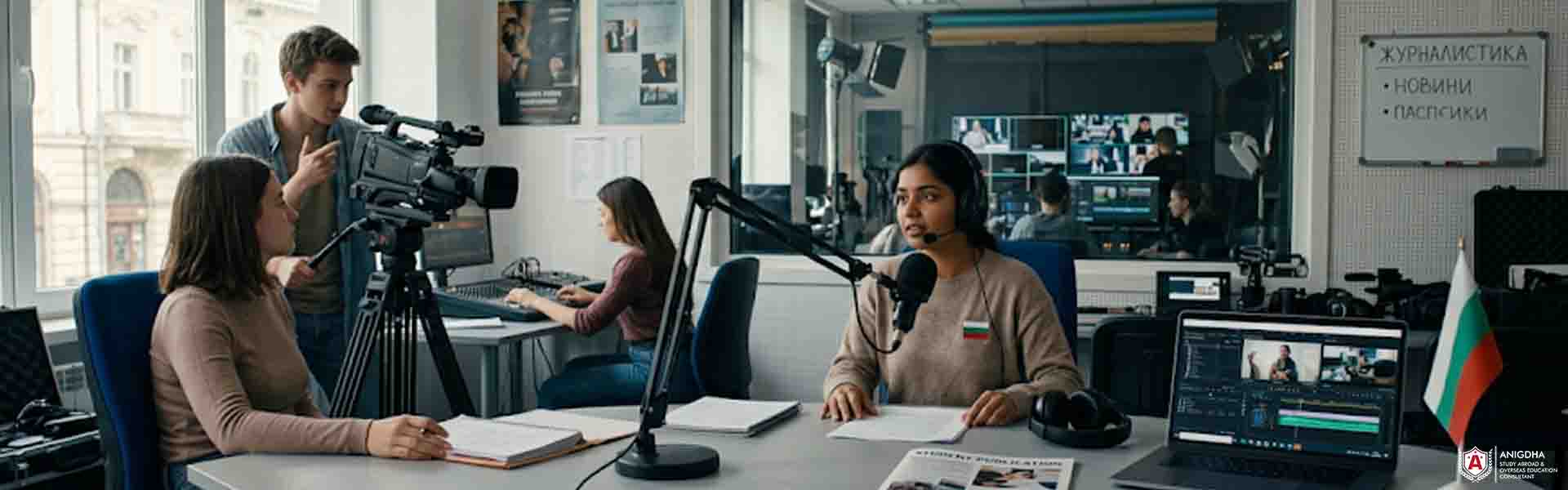
- Practical exposure: Some universities in Bulgaria can also give you access to student radio, TV studios and campus magazines. This can help you get practical experience along with your academic classes.
- Recognised European degree: A journalism and mass communication degree in Bulgaria holds the same value as a degree from any other EU country. This can be a good choice if you want to build a career or study further in Europe.
- Diverse student community: Bulgaria welcomes students from many countries, so you get exposed to different cultures and perspectives. This can add real value to your overall college experience.
- Growing digital industry: Bulgaria has a growing media, marketing and digital content sector. This can open wide career paths for you within the country and across Europe.
- European travel access: Bulgaria is part of the European Union, so a single residence permit can let you travel to other member countries during your holidays or study breaks.
- Modern university infrastructure: Several Bulgarian universities have updated their libraries, media labs and equipment in recent years. This can help you work with current industry practices.
Am I Eligible to Study Journalism and Mass Communication in Bulgaria?
If you are an international student willing to study bachelors in journalism and mass communication in Bulgaria, here is the eligibility criteria you need to fulfill:
- Students should have pursued schooling up to 10+2 level and scored at least 62% marks in the passing year.
- Students should also be able to submit a statement of purpose as well as letters of recommendation.
- Some institutions demand that students appear for an interview in order to prove their ability to study journalism and mass communication in Bulgaria.
- Students must also portray their proficiency in the English language. For this, they must appear for tests like IELTS, TOEFL or PTE.
| Test | Score Required |
| TOEFL | 80 |
| IELTS | Band 6 |
| Cambridge First Certificate English (FCE) | Pass grade C |
| Cambridge Advanced English Certificate (CAE) | Pass grade C |
English Taught Journalism and Mass Communication Programs in Bulgaria
The journalism and mass communication programme in Bulgarian universities is taught in English at both levels, including bachelor’s and master’s. Hence, you must score the required marks in English language proficiency tests to secure your admission.
Journalism and Mass Communication Intakes and Application Deadlines in Bulgaria
There are two intakes for international students willing to study journalism and mass communication in Bulgaria. For the fall intake, the application deadline is around the second week of November. On the contrary, it is around the second week of March for the summer intake.
What Documents Do I Need to Study Journalism and Mass Communication in Bulgaria?
Listed below are the necessary documents that students need to submit to the university to complete the application process for journalism and mass communication in Bulgaria:
- English proficiency certificates.
- Transcript of education up to the qualifying examinations.
- Visa.
- Passport.
- Medical Certificate.
- Proof of Funds.
- Photographs (passport-sized).
- Mark sheets of 10+2 levels or your bachelor’s degree certificate and transcripts if you are applying for a master’s in Bulgaria.
- CV or Portfolio.
- Statement of purpose or letters of recommendation.
Not sure if your documents are in order? We can review your checklist before you apply.
Duration of Journalism and Mass Communication Programs in Bulgaria
The total duration of a bachelor’s course in journalism and mass communication in Bulgaria is usually 4 years. This duration is divided into 8 semesters at the end of which there will be an examination to test the student’s preparation. A master’s programme in this field usually takes 1 to 2 years, depending on the university.
Cost of Studying Journalism and Mass Communication in Bulgaria
The fee structure for studying journalism and mass communication in Bulgaria varies quite a bit between universities. Let us have a look at the details for the same:
| University Name | Fees per Year |
| American University in Bulgaria | Around €12,900 |
| Sofia University “St. Kliment Ohridski” | Around €1,500 to €3,000 |
| New Bulgarian University | Around €2,500 to €4,500 |
| South-West University “Neofit Rilski” | Around €2,000 to €3,500 |
Want the exact journalism and mass communication fees in Bulgaria for your shortlisted university? We can help you compare them.
Top Universities for Journalism and Mass Communication in Bulgaria
Are you seeking the Top university in Bulgaria from where you can pursue a degree program with journalism and mass communication as your specialization? Below are the details about the leading universities:
| University Name | Category | City |
| American University in Bulgaria | Private | Blagoevgrad |
| Sofia University “St. Kliment Ohridski” | Public | Sofia |
| New Bulgarian University | Private | Sofia |
| South-West University “Neofit Rilski” | Public | Blagoevgrad |
How Much Does It Cost to Live in Bulgaria as a Student?
Apart from your tuition fee, you also need to think about your monthly living cost while you study journalism and mass communication in Bulgaria. Here is the exact Bulgaria fee structure for your daily expenses:
- Accommodation: A university dormitory costs around €50 to €100 per month while a private studio or shared flat costs around €200 to €400.
- Food and groceries: You can expect to pay around €150 to €250 per month while a canteen meal costs around €3 to €5.
- Transport: A student monthly pass for buses, trams and the metro costs around €10 to €30.
- Utilities: Electricity, water and heating together cost around €60 to €100 per month.
- Internet: A good connection costs around €10 to €15 per month.
- Personal expenses: Clothing, entertainment and mobile recharge cost around €50 to €100 per month.
All these expenses together come to around €500 to €700 per month, which is close to ₹47,000 to ₹66,000 in Indian rupees. At last, compare this with your journalism and mass communication fees in Bulgaria to plan your full budget.
Scholarships and Financial Support available to study Journalism and Mass Communication in Bulgaria
If you are also worried about the journalism and mass communication fees in Bulgaria, you can look at a few scholarship options to bring your cost down. Here are the options you can consider:
- The Bulgarian Government Scholarship comes through the Ministry of Education and Science under agreements between Bulgaria and other countries.
- Several journalism and mass communication universities in Bulgaria can also give a fee discount to students with a good academic record.
- Erasmus+ lets you spend a semester or two at a Bulgarian university if you come through an exchange programme. This mainly depends on your home university holding an agreement.
- Indian students can also apply for government scholarships in India that support study abroad. You can hold this alongside any scholarship you get in Bulgaria.
The current eligibility for each option can differ, so it is always good to confirm this with your Bulgarian university before you apply.
Want help finding the right scholarship for your course? Our team is happy to guide you.
How to Apply for Journalism and Mass Communication in Bulgaria?
After understanding the different aspects of this degree, you must be interested in knowing more about how you can get admission to the course program. Don’t worry, the process is very simple. Moreover, if you are seeking guidance, our expert counselors are here to help you. In the pointers below, we will explain the step-by-step process of admission to study journalism and mass communication in Bulgaria:
- Even before the Bulgarian admission process begins, you need to understand which course is best suited for your career to thrive. Hence, you can schedule a consultation with our experts who will understand what topics interest you and then help you decide which is the best course for you.
- The next step is choosing the ideal university that meets your requirements. This involves an analysis of the different facilities provided, the experience of the faculty members, as well as the excellence of the curriculum.
- Then, we will help you understand the journalism and mass communication admission requirements set by the university. If there are any entrance or language proficiency tests, we will guide you through them as well.
- After this, you need to correctly fill out the application form and submit it on time. Many students either end up being late for the submission or fill in some sections incorrectly. This may cause your application to not be accepted.
- You also have to ensure that you have all the documents in the right place so that your admission process is seamless. Our team will give you a comprehensive checklist of the documents required for the university you have chosen.
- Studying at a foreign university also involves the seemingly lengthy process of Bulgaria study visa but with our support by your side, you will be able to understand the process easily.
- We also guide you regarding the accommodation options and other essentials. This is our way of ensuring your comfort while pursuing a prestigious degree in a new country.
Journalism and Mass Communication in Bulgaria vs Other European Countries
If you are still confused about your choice, then here is a clear comparison of study journalism and mass communication in Bulgaria with other European countries:
- Admission process: Getting into a Bulgarian university is simple and easier while European countries like Germany and the Netherlands have a long and detailed admission process for the same course.
- English taught programs: One of the best reasons to choose this country is the fully available English taught programs in Bulgaria. However, countries like Germany only support English at the master’s level instead of providing a bachelor’s in English.
- Tuition fees: Bulgaria is one of the affordable countries with a fee structure around €2,000 to €4,000 per year. However, a similar course in the Netherlands can go up to €11,000 to €18,000 per year.
- Cost of living: The cost of living in Bulgaria is usually cheaper when compared with other countries. It can range around €500 to €700 while Germany and the Netherlands can cost you almost double this amount every month.
- Scholarships: Bulgaria offers modest scholarship support through the government and universities. However, Germany and the Netherlands offer bigger scholarships with higher levels of competition.
- Degree recognition: A journalism degree from Bulgaria carries the same value as one from any other EU country. This stays equal no matter which country you choose.
Career Scope After Journalism and Mass Communication in Bulgaria
After you complete your journalism and mass communication degree in Bulgaria, you can get to explore several career opportunities across media, marketing and communication. Here are the roles you can consider:
- Journalist or news reporter
- TV or radio host
- Content creator and digital storyteller
- Copywriter
- Public relations professional
- Digital marketing and social media specialist
- Video, documentary or podcast producer
According to industry reports, employers usually ask for practical experience in this field, so it can be beneficial if you join an internship alongside your course. As an Indian student, you can also enjoy the benefits of international exposure and explore good opportunities back home, such as media houses, PR agencies and digital marketing firms.
Curious which of these roles fits your interest best? Our team can help you with the right guidance !
Tips for Indian Students Applying to Journalism and Mass Communication in Bulgaria
Before you finalise your decision to study journalism and mass communication in Bulgaria, follow these points carefully:
- Read the course structure at every journalism and mass communication university in Bulgaria and check if it aligns with your own interest, like reporting, PR or digital media.
- Before applying, please read the eligibility criteria carefully and understand all the entrance requirements or exams.
- Confirm the language of your course early as this can be English or Bulgarian depending on the university.
- Create a portfolio of your writing, photos or videos before you apply. This can add value to your application.
- Also, look for an internship related to your course as this can help you get real experience in this field of study.
- Check the official website and compare the total cost of studying journalism and mass communication in Bulgaria, then choose an appropriate university according to your budget and need.
- If you are applying for a Bulgaria student visa, always try to apply early, as it is a long process which can take time to sort out.
Related Courses
A journalism and mass communication degree can open a rewarding path for your future and Bulgaria makes this possible at an affordable cost. If you plan to study journalism and mass communication in Bulgaria, you can begin your degree with a recognised European foundation and step into a growing media industry after graduation.
Ready to take the first step? Contact Bulgarian education consultants for the right guidance!
Frequently Asked Questions
Yes, Bulgaria offers English taught programs and an affordable overall cost compared to Western Europe, along with a recognised EU degree at the end of your course.
The fee for this course usually ranges from around €2,000 to €13,000 per year. Public universities charge an affordable fee, while private universities like American University in Bulgaria charge a higher fee.
A bachelor’s programme usually takes 4 years, divided into 8 semesters. However, a master’s programme usually takes 1 to 2 years.
Yes, the degree is recognised across the European Union. You need to include it in the Association of Indian Universities equivalence list for full recognition in India.
If you are interested in the different topics included in journalism and mass communication, pursuing this degree will seem easy to you. However, if this subject is not something you like, you will face numerous challenges during the degree’s duration.
Yes, there are many interesting job roles for graduates of journalism and mass communication. These include TV hosts, copywriters, journalists, radio hosts, event managers, digital marketing specialists, etc.
No. Studying bachelors in journalism and mass communication is very affordable at universities in Bulgaria. This can be attributed to the low tuition fee charged, even for international students.
Last Updated: October 16, 2026