
Study Electronics in Bulgaria: A Complete Guide for Indian Students
Study electronics in Bulgaria and get a recognised European degree at an affordable fee. An Electronics course in Bulgaria is a degree program that focuses on the design and implementation of electronic devices. One of humanity’s greatest achievements is electricity. The requirement for and application of electricity have developed in tandem with the passage of time and the introduction of new technologies. This program requires students to learn about and analyze a wide variety of machinery and equipment types, as well as the inner workings of electronic circuits, control systems and power electronics. An electronics engineer’s contributions to society are crucial. They are in charge of creating and maintaining a wide variety of crucial tools and devices. The engineering programs in Bulgaria are well recognised across Europe. A UG electronics degree in Bulgaria is also affordable because of the country’s open educational system, which is why higher education in Bulgaria is a popular choice among Indian students. If you want to study electronics in Bulgaria for Indian students, keep reading.
In this guide, we are going to include:
- Eligibility requirements and documents for electronics admission in Bulgaria
- English taught electronics programs in Bulgaria
- Application dates and the Bulgaria university application process
- Course duration and the top electronics universities in Bulgaria
- Electronics fees in Bulgaria and the cost of living in Bulgaria for students
- Scholarships in Bulgaria for international students
- Bulgaria student visa requirements
- Career options after your electronics degree in Bulgaria
Why Study Electronics in Bulgaria?
If you are an Indian student looking for an affordable and recognised technical degree, then Bulgaria can be a good option to consider. Every year, a large group of students choose to study electronics in Bulgaria as it offers quality education at a lower cost. Here are the main benefits you can enjoy:
- Affordable fees: The electronics fees in Bulgaria are much lower than countries like the UK, Germany or Canada, so you can complete your degree within a student-friendly budget.
- English-taught courses: Some universities offer English taught programs in Bulgaria, so you do not need to study any additional language to start your electronics course in Bulgaria.
- Recognised degree: An electronics degree in Bulgaria is recognised across the European Union, so you can also apply for jobs in India and other European countries.
- Low living cost: The cost of living in Bulgaria for students is one of the lowest in Europe including rent, food and travel expenses that are easy to manage.
- Growing tech industry: Cities like Sofia and Plovdiv have electronics and technology companies that hire engineers, so you can explore internships and job opportunities close to your university.
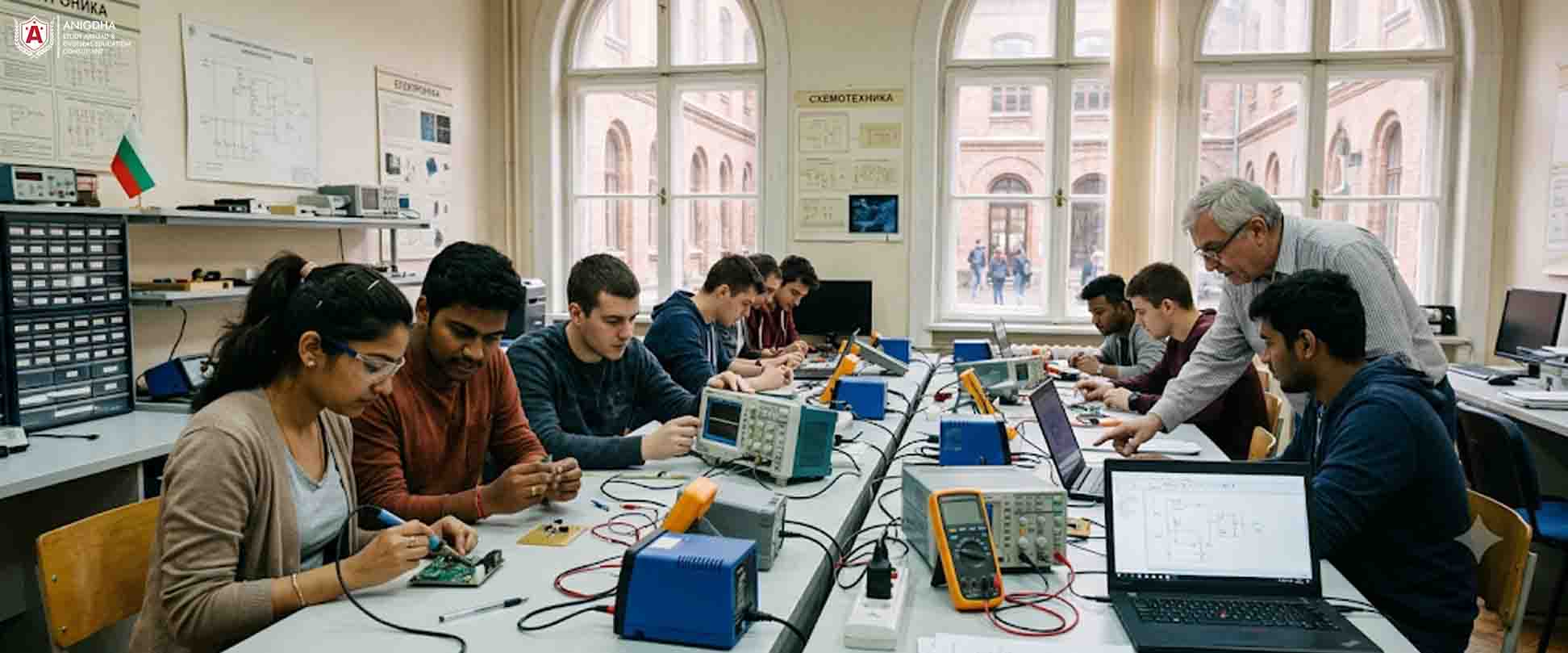
- Practical learning opportunity: Some electronics courses also include laboratory work and projects, so you get to apply your subjects on real circuits and devices.
- Higher studies in Bulgaria: After you complete your bachelors in electronics, you can continue with Masters in Bulgaria and specialise in a field of your choice.
- Scholarship options: Some universities offer scholarships in Bulgaria for international students based on your academic performance, which can reduce your fee burden.
What Are the Eligibility Requirements for Electronics in Bulgaria?
If you want admission in bachelors in Bulgaria for electronics, it is essential that you take notice of the specific requirements for applying to and being accepted into the electronics bachelor’s program. Here are the admission requirements that you generally need to meet for electronics admission in Bulgaria:
- Students must obtain a diploma from an accredited institution in order to demonstrate that they have met the requirements for high school graduation.
- The minimum cut-off is usually 62% in 10+2 in order to be eligible. Students should try to aim as high as possible.
- Various proficiency tests for language are required to prove your capabilities for English taught programs in Bulgaria. In order to do so, students need to score more than 90 on TOEFL, 6.5-7 in IELTS or over 60 in PTE. Students can choose one of these language proficiency exams based on what their university of choice requires. If your score is low, you can also look at preparatory Courses in Bulgaria before starting your degree.
- The ideal background for an electronics degree in Bulgaria is a 10+2 in science with Physics, Maths and computer applications classes.
- Some universities may also ask for an entrance test or an online interview, so check this in the Bulgaria university application process of your chosen university.
- Before beginning their studies in Bulgaria, Indian students must apply for a Type D Bulgaria student visa through VFS Global, which works with the Bulgarian Embassy. To be granted the Bulgaria student visa for electronics, it is essential to confirm that you have completed all prerequisite steps.
Can You Study Electronics in English in Bulgaria?
Yes, you can study electronics in Bulgaria in English. The language of instruction for most of the bachelor courses in Bulgaria is English. Hence, all the applicants are advised to provide the evidence of qualifying English proficiency exams like IELTS and TOEFL when applying. Some universities may also accept their own English test or an online interview, so check this with your chosen university.
When to Apply for Electronics Courses in Bulgaria?
April to September is frequently the window for submitting applications to electronics programs offered by Bulgaria universities. Before picking up the form and filling it out, students must certify that they are able to participate and have met the prerequisites. However, the deadline for electronics admission in Bulgaria 2026 can differ from one university to another, so always check the exact dates on the university website.
What Documents Do You Need to Study Electronics in Bulgaria?
The required paperwork for students who wish to complete a UG degree in an electronics engineering program comprises:
- High school diploma or a comparable qualification.
- Academic transcripts.
- Proof of English language proficiency.
- A copy of your passport.
- Recent passport size photographs.
- Curriculum Vitae (CV).
- Statement of Purpose (SOP).
- Letters of Recommendation.
- Application form and verification of payment for the application fee.
Thus, keep these documents ready before you start the Bulgaria university application process.
Electronics Course Duration in Bulgaria
Full-time students can expect to earn their electronics degree in Bulgaria in four years. If you want to continue, master courses in Bulgaria for electronics usually take one to two years. In addition to flexible class schedules, students have the option to pursue their studies part-time.
Cost of Studying Electronics in Bulgaria
Funding is available for electronics majors at both public and private institutions. If you are an international student and want to study engineering, you should apply for one of the numerous available scholarships. The cost to study electronics in Bulgaria is lower than in most European countries. The following table details all university costs in Bulgaria:
| UNIVERSITY NAME | FEE STRUCTURE |
|---|---|
| Technical University of Varna | 2440 EUR / Year |
| Technical University Sofia | 4730 EUR / Year (2365 EUR / Semester) |
| Sofia University ST. Kliment Ohridski | 5650 EUR / Semester (11300 EUR / Year) |
| American University of Bulgaria | 6900 EUR / Semester (13800 EUR / Year) |
Top Universities for Electronics in Bulgaria
There are different universities that you can enroll in. We have listed these top universities in Bulgaria for you. You need to check out these electronics universities in Bulgaria for your electronics degree in Bulgaria:
| UNIVERSITY NAME | CATEGORY | CITY | NATIONAL RANKING |
|---|---|---|---|
| Technical University of Varna | Public | Varna | 4 |
| Technical University of Sofia | Public | Sofia | 1 |
| Sofia University St. Kliment Ohridski | Public | Sofia | 3 |
| American University in Bulgaria | Private | Blagoevgrad | 42 |
How to Get Admission to an Electronics Program in Bulgaria?
The admission procedure for a UG degree in electronics engineering in Bulgaria involves a structured process to ensure a seamless transition for international students:
- Firstly, students can consult our dedicated counselor. We will then meticulously research and provide information about universities in Bulgaria and available electronics courses in Bulgaria.
- Furthermore, we will either apply for the chosen courses on the student’s behalf or assist students in filling the application form and paying the application fee. This makes the Bulgaria university application process easy.
- We will also assist in the preparation for language proficiency exams, a crucial requirement for non-native speakers.
- Lastly, our team will assist with the Bulgaria student visa for electronics, ensuring that aspiring electronics engineers can pursue their academic dreams in Bulgaria with ease and confidence. We guide you through the full Bulgaria electronics visa process.
- Ultimately, we can also arrange accommodation facilities for students who wish to pursue their courses in Bulgaria.
Bulgaria Student Visa for Electronics Students
If you plan to study electronics in Bulgaria, you generally need a long stay Type D visa. This visa is needed for a duration longer than 90 days. It is the first step towards your residence permit in Bulgaria.
Indian students need to submit the Type D application through the VFS Global centres in India. Here are the documents you generally need to prepare for your Bulgaria student visa to study electronics:
- A university admission letter as proof of your enrollment.
- Valid passport and completed visa application form.
- Your recent passport size photographs.
- A proof of accommodation in Bulgaria.
- Travel health insurance for your stay.
- Bank statements as proof of sufficient funds.
The processing time depends on your application and the embassy workload and it usually takes several weeks. You may also need to appear for a personal interview. These requirements and appointment slots can change from time to time, so you can check the latest Bulgaria study visa requirements on the official embassy or VFS Global website. After you arrive in Bulgaria, you need to apply for a long term residence permit. It is usually issued for one year and renewed each year while you continue your course.
How Much Does It Cost to Live in Bulgaria as a Student?
Apart from the tuition fee, you also need to consider the living cost before planning to study electronics in Bulgaria. As compared to other European countries, Bulgaria is considered an affordable choice. Here is the breakdown of cost of living in Bulgaria for students across the following categories:
- Accommodation: It is generally affordable but the price can change depending on the city and neighbourhood you choose. A university dormitory usually costs around €100 to €200 per month while a shared flat can costs around €200 to €400.
- Food and groceries: This depends on your shopping habits and location. A single person typically needs around €150 to €250 per month while a meal at a university canteen costs around €3 to €5.
- Transport: Public transport in cities like Sofia and Plovdiv is affordable. A student monthly pass for buses, trams and the metro usually costs around €10 to €25.
- Utilities and internet: This depends on the season and your accommodation type. Electricity, water and heating together usually cost around €60 to €100 per month and the internet adds around €10 to €15.
- Health insurance: This depends on the coverage you choose. Travel medical insurance with €30,000 coverage usually costs around €50 to €100 per year.
- Personal expenses: Clothing, entertainment and mobile recharge usually add up to around €50 to €100 per month.
Thus, your total monthly budget usually comes to around €500 to €700. In Indian currency, the Bulgaria living cost in Indian rupees comes to around ₹45,000 to ₹80,000 per month. Once you know this amount, you can compare it with the electronics fees in Bulgaria at your chosen university.
Scholarships and Financial Support for Electronics Students in Bulgaria
A scholarship can make your electronics fees in Bulgaria easier to manage, so it is good to explore all the options. Here are the main scholarships in Bulgaria for international students that you can explore:
- Bulgarian Government Scholarship: The Ministry of Education and Science offers this support under agreements between Bulgaria and other countries. However, the eligibility criteria for Indian students can change, so you need to confirm the current position with your university.
- University scholarships: Some electronics universities in Bulgaria reward good marks with a reduction in tuition fee. Each university sets its own criteria and the details are listed on its official scholarship page.
- Erasmus+: This EU programme supports a semester or a full year at a Bulgarian university. It is meant for exchange students so your home university needs to have an agreement in place.
- Home country schemes: Indian students can also apply for central or state government education schemes for overseas study. These can run alongside any support you receive in Bulgaria.
Thus, application dates change from one scholarship to another, so you need to note them down early and plan them alongside your Bulgaria university application process.
What Can You Do After Studying Electronics in Bulgaria?
After you complete your electronics degree in Bulgaria, you can get to explore several career opportunities in a growing technology sector. Some popular cities like Sofia and Plovdiv have well recognised electronics manufacturers and design centres that hire engineers. Here are the career paths that you can consider:
- Electronic design engineer
- Embedded software or firmware engineer
- Hardware and PCB design engineer
- Testing and quality engineer
- Analog and IC design engineer
- Maintenance engineer for electronic and production systems
If you want to continue your studies, you can pursue a master’s in electronics, as higher education in Bulgaria offers specialised programmes at several universities. Therefore, your degree is recognised across the European Union, so you can also apply for jobs in other European countries.
Planning to study electronics in Bulgaria? Our team is here to guide you towards the right career path.
Related Courses
Thus, Bulgaria gives you an affordable and recognised way to study electronics in Bulgaria. There are many well recognised universities that offer widely accepted degrees across the European Union. This means you can explore several job opportunities in Bulgaria, Europe and India after you graduate. If you are planning to build a career in electronics, guidance from experts can make this process easy for you.
Frequently Asked Questions
Yes, electronics in Bulgaria is a good option for Indian students as it offers affordable fees, English-taught programmes and a degree recognised across Europe.
The Technical University of Sofia is one of the top choices. It is the largest technical university in Bulgaria and offers Electronic Engineering in English.
A bachelor’s in electronics generally takes 4 years while a master’s programme usually takes 1 to 2 years, depending on the university.
Yes, Indian students can apply after completing 12th with Physics, Chemistry and Mathematics along with the English proficiency requirement of the university.
Yes, English-taught programmes usually ask for an IELTS or TOEFL score, or the university’s own English test.
Not necessarily, as admission in Bulgaria is based on your marks and documents. Some may conduct an interview or a short test in Mathematics and Physics.
Yes, a degree from a recognised Bulgarian university is accepted in India but you may need an equivalence certificate for jobs or higher studies.
Yes, you can apply for jobs in India after your degree. It is best to get your degree verified or recognised in advance.
A student usually needs around €500 to €700 per month or roughly ₹50,000 to ₹70,000. It majorly depends on the city and lifestyle.
A UG degree in Electronics from a private institution in Bulgaria may cost 6,000 Euros to get.
Last Updated: October 16, 2026