
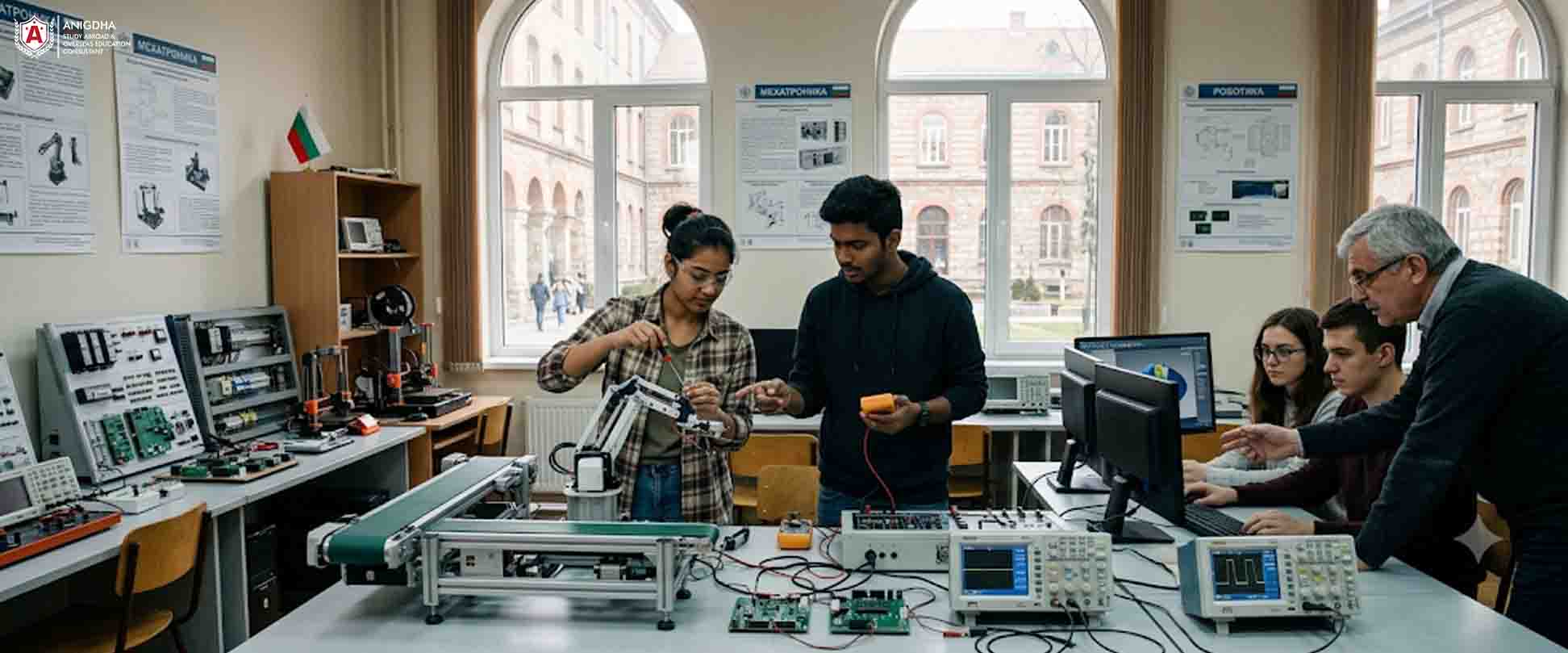
Study Mechatronics in Bulgaria: Courses, Fees, Universities & Admission
A career in Mechatronic Systems can take you into different fields and Bulgaria gives you an affordable path to build that foundation. Study mechatronics in Bulgaria and build a rewarding career. It is a branch of study that introduces students to mechanics, robotics, electronics, and automatic control. The field produces talented engineers who can design, develop, and test a range of advanced, automated machines. During the 4-year study program, students learn the fundamentals of creating next-gen devices, which make decisions and prioritize actions. If you want to learn the nuances of how a robot is made, how an AI model performs, or how the internal systems of an advanced engineering machine work, mechatronics in Bulgaria is an ideal choice for you.
The program will teach you everything about engineering processes, product design, and the use of computer-aided design (CAD) software or digital electronics. Throughout your study, you will develop mathematical and technical acumen, work on logical analysis, project management, and the ability to work within teams. Bulgaria is home to many universities offering mechatronics courses for Indian students, at affordable fees, and students can also get scholarships to reduce the cost. Let us break down the process of admission for you.
In this guide, we are going to explore the eligibility, fees, universities, admission process and career opportunities for Mechatronic Systems in Bulgaria, so you have everything you need before you apply.
Mechatronic Systems in Bulgaria: Course Overview
| Particulars | Details |
| Course Name | Mechatronic Systems |
| Duration | 4 years (Bachelor’s), 1 to 2 years (Master’s) |
| Medium of Instruction | English |
| Intakes | Fall (September) and Spring (February) |
| Average Tuition Fee | €2,000 to €4,000 per year |
| English Requirement | IELTS/TOEFL or university’s own English test |
Why Study Mechatronics in Bulgaria?
If you have chosen to study Mechatronics in Bulgaria as your next destination then you must look at its benefits:
- Affordable fees: Mechatronics tuition fees in Bulgaria can be more budget friendly than in several other European countries, including Germany and the UK.
- English medium course: If you prefer studying in English, you can find several English taught Mechatronics programmes in Bulgaria.
- Recognised degree: A Mechatronics degree from a recognised Bulgarian university can give you access to career opportunities across the European Union, subject to the relevant requirements.
- Low living cost: Bulgaria has relatively affordable living costs for students compared with several other European destinations, although it can differ by city you choose.
- Growing industrial hub: Cities like Sofia and Plovdiv have well-developed manufacturing and technology sectors which can give you valuable exposure to internships and jobs during your studies
- Scholarship options: Several Bulgarian universities offer generous scholarships to eligible international students that may significantly reduce your overall study costs.
- Access to the Schengen Region: Bulgaria became a full Schengen member from January 2025. This can give you easy access to travel across other Schengen countries during your study period.
Mechatronics Eligibility Criteria in Bulgaria
Discover the eligibility criteria you must fulfil before you study mechatronics in Bulgaria:
- Entry-Level Tests: Students must sit for mandatory entry-level tests. The tests are conducted in the English language, and you can secure admission only after clearing them.
- Educational Requirements: You can apply for a mechatronics degree in Bulgaria if you have secured 62% and above in your qualifying education, with physics and mathematics as your main subjects.
- English Proficiency Test: Applicants with basic English language proficiency can sit for the university entry test. If you pass, you will be enrolled in your preferred degree course for the first year of study. Otherwise, you must attend 10 months of preparatory courses in Bulgaria, depending on the language in which the specialty is offered.
Here are the levels of proficiency required in the English language:
- IELTS: minimum score required 6.5
- TOEFL Paper, CBT, IBT: minimum 550, 213 or 79 score respectively
- PTE General: third level minimum
- PTE Academic: minimum score needed is 59
Bulgarian universities conduct the English proficiency tests themselves, and the primary focus of these universities is on a student’s IELTS and TOEFL score, which should be above 6.5 and 81 respectively.
English-Taught Mechatronics Courses in Bulgaria
English is an international language, but if you know the regional language a bit it will work in your favour. Universities in Bulgaria use English as an optional language. The English language option is for international students because it is a global course, and this makes it one of the popular English taught programs in Bulgaria.
Mechatronics Course Duration in Bulgaria
Before you start to apply to various Bulgarian universities to secure admission for a Bachelor’s in Mechatronic Systems, know the last dates of form submissions. Generally, universities accept new admission forms and applications from April to September for mechatronics admission in Bulgaria.
Mechatronics Admission Documents in Bulgaria
Check the list below mentioning the essential documents an applicant must submit at the time of application for the mechatronics courses in Bulgaria:
- Eligibility documents – One must submit a document by competent authorities testifying the right of the applicant to continue his/her higher studies at the university in the country from where they have completed their secondary education.
- Application documents – Application form with brief biographical data, exact address, telephone, and the label of the applicant’s desired specialty. The Application form is available to be downloaded in Word format.
- Educational documents – Copy of your High School Diploma and other supplements. Minimum 62% passing marks required to secure admission in a mechatronics degree in Bulgaria. The main subjects of study should be physics and mathematics.
- International documents – Please provide an original photographic copy of the applicant’s passport.
- Identification documents – You must submit your four latest passport-sized photos.
Duration of the Computer Science Program
Each university has its own distinct protocol and duration of courses. Generally, a mechatronics degree in Bulgaria is a 4-year course, divided into eight semesters—two semesters per year. Our educational consultants at our team can help you with the details of the course at the university of your choice.
Cost of Studying Mechatronics in Bulgaria
Before seeking admission to a mechatronics course in Bulgaria, it is essential to know the costs involved. Here is the fee structure of some of the most renowned universities:
| Name of the University | Fee structure per year |
| Technical University of Sofia | 3000 EUR/Year |
| Technical University of Varna | around 3000 EUR/Year |
| University of Ruse “Angel Kanchev” | around 3400 EUR/Year |
Additional Costs of Studying Mechatronics in Bulgaria
Along with the tuition fees in Bulgaria, you may have some extra expenses to study mechatronics in Bulgaria:
- Lab and workshop sessions can cost around €100 to €300 per year, as it includes practical training.
- A suitable laptop can cost around €400 to €800 and can help you with design and simulation work during the course.
- Some Mechatronics courses may require CAD and automation software, which can cost around €50 to €150 per year.
However, the exact costs depend on the university, so it is better to confirm them before you apply for a Bulgarian university application form.
How Much Does It Cost to Live in Bulgaria as a Student?
As compared to other European countries, Bulgaria is considered an affordable choice. Here is the breakdown of the cost of living in Bulgaria for students across the following categories:
| Expenses | Estimated Monthly Cost |
| Accommodation | €150 to €400 |
| Food & groceries | €150 to €250 |
| Transport | €10 to €25 |
| Utilities & internet | €70 to €115 |
| Health insurance | €4 to €8 (yearly cost divided monthly) |
| Personal expenses | €50 to €100 |
Thus, your monthly cost of living in Bulgaria usually comes to around €500 to €700. According to Indian currency, the Bulgarian living cost in Indian rupees comes to roughly ₹45,000 to ₹65,000. Therefore, you can compare it with the mechatronics fees in Bulgaria at your chosen university and plan your overall cost of studying in Bulgaria.
Mechatronics Scholarships in Bulgaria
If you are looking to study mechatronics in Bulgaria for free, you can find several scholarships to reduce your fees. Bulgaria does not have one scholarship that covers your full degree automatically, so you need to check the eligibility of each option. Here are the main scholarships you can consider:
- Erasmus+ scholarship: This programme supports student exchange and mobility across European universities. It can cover tuition fees along with a monthly allowance during your exchange semester.
- University Merit Scholarships: Some universities in Bulgaria also offer their own scholarships to students with good academic records. The amount and eligibility criteria can differ from one university to another.
- Bulgarian Government Scholarships: The Bulgarian Ministry of Education and Science offers scholarships to choose international students each year, though the seats and subjects covered can change annually.
The mechatronics fees in Bulgaria are already lower than most European countries, so a scholarship on top of this can bring your cost down even further. Some university-specific scholarships are only open to EU students, so it is necessary to read the nationality rules before you apply.
Best Universities for Mechatronics in Bulgaria
Bulgarian universities have designed their degree courses to impart the up-to-date skills to their students. Here are the details of some of the most popular universities for mechatronics in Bulgaria:
| Name of the University | Category | City |
| Technical University of Sofia | Public | Sofia |
| Technical University of Varna | Public | Varna |
| University of Ruse “Angel Kanchev” | Public | Ruse |
Mechatronics Admission Process in Bulgaria
Applicants are required to follow a standard procedure set by the university authorities. Here’s how to do it and how our educational consultant will be there for you at every step:
- At our team, our experts will provide you with all the information you need about courses and the colleges of your choice.
- We will give you details about the entrance tests and exams.
- We will share the details and list of documents requested by the university of your choice.
- We can complete your application form at an affordable rate.
- Bulgarian universities may require you to pass through university-sponsored entrance examinations or produce evidence of your readiness for a nationally based examination fully funded by the government. We will guide you through the process.
- If some universities conduct interviews, our team will help you prepare for them.
- Some of the colleges would need you to sit for an English entry exam or show your foreign exam transcripts on English proficiency tests. We will prepare you for these tests.
- The college will send you an approval notification. Our team will keep you updated about all the necessary communication.
- Our team will also help with visa procedures and accommodations.
Mechatronics in Bulgaria vs Other European Countries
Students planning to study mechatronics in abroad often explore different countries before choosing one, so here is a genuine comparison between Bulgaria and other popular European countries:
| Factor | Bulgaria | Other European Countries |
| Tuition Fees | The mechatronics fees in Bulgaria range between €2,000 to €4,000 per year. | Countries like Germany or the UK charge €8,000 to €15,000 per year. |
| Cost of Living | The cost of living in Bulgaria for students is around €500 to €900 per month. | Living costs in Western Europe go up to €1,200 to €1,800 per month. |
| Language of Instruction | English taught programs in Bulgaria are widely available. | English-taught options exist but at a much higher fee. |
| Degree Recognition | A mechatronics degree in Bulgaria is recognised across the EU. | Similar recognition, but at a higher cost. |
| Visa Process | The Bulgaria student visa process is simple and quick. | Often longer, with a detailed list of documentation. |
| Career Scope | Access to the European job market after your mechatronics course in Bulgaria. | Strong scope too but with higher competition. |
Therefore, Bulgaria gives you a real European experience at an affordable fee without compromising the quality of your education.
Career Scope After Mechatronics in Bulgaria
Once you complete your mechatronics degree in Bulgaria, several career paths open up for you. Here are the roles you can explore:
- Mechatronics Engineer
- Robotics Engineer
- Automation Engineer
- Control Systems Engineer
- Product Design Engineer
- Industrial Engineer
- Maintenance and Process Engineer
Today, industries like manufacturing or automotive actively hire graduates from mechatronics. A fresher in this field can generally expect a starting salary of around €800 to €1,200 per month and this can grow well with experience and skill. Therefore, a mechatronics degree in Bulgaria can help you build a strong base for a technical career. If you want to specialise further, you can also pursue masters in Bulgaria in a related field.
Things to Check Before Applying for Mechatronics in Bulgaria
Before you apply for a mechatronics course in Bulgaria, here are a few things you should check properly:
- Always confirm that your chosen university is officially accredited, so your mechatronics degree in Bulgaria is valid and recognised across the world.
- Compare the mechatronics fees in Bulgaria across a few universities before you decide, as the fee structure can vary from one institution to another.
- Check whether your programme falls under English taught programs in Bulgaria and confirm the exact English proficiency level your university expects.
- Look into the lab facilities and equipment offered by the university, as mechatronics is a practical subject that needs hands-on training. This can let you gain practical experience through the course.
- Confirm if the course includes an internship or industry project, as this adds real value to your mechatronics degree in Bulgaria once you start job hunting.
- Look into your shortlisted university offers and search for the scholarships in Bulgaria for international students. This can bring down your overall fee.
- Do not wait until the last minute to apply for your Bulgaria student visa. Start early so you have enough time before your intake.
Related Courses
Your search to study Mechatronics in Bulgaria ends here! Bulgaria gives you a European degree at an affordable cost, along with a real exposure to a growing manufacturing and automation industry in cities like Sofia and Plovdiv. This, a Mechatronics degree from Bulgaria can be recognised across the EU while giving you more options for your career and further studies.
Ready to take the next step? Reach out to us and start your mechatronics journey in Bulgaria today.
Frequently Asked Questions
Mechatronics includes mechanical, electrical and computer engineering, which opens career paths in robotics, automation and product design.
Yes, cities like Sofia and Plovdiv have growing manufacturing and technology industries that offer internships to mechatronics students.
You can work as a mechatronics engineer, robotics engineer, automation engineer or control systems engineer, both in India and Europe.
Yes, it is a good option, as Bulgaria offers affordable fees, English-taught programmes and a degree recognised across the European Union.
The fees generally range between €2,000 to €4,000 per year, depending on the university and programme structure.
Not always. Some universities may ask for a short test in Physics and Mathematics, while others admit based on academic records.
A bachelor’s in mechatronics generally takes 4 years, while a master’s programme usually takes 1 to 2 years.
Yes, a degree from a recognised Bulgarian university is accepted in India, though recognition can also depend on the institution.
Last Updated: October 16, 2026